
Are you ready to change? This is your moment
Season 4 • EP 09 • October 7, 2025

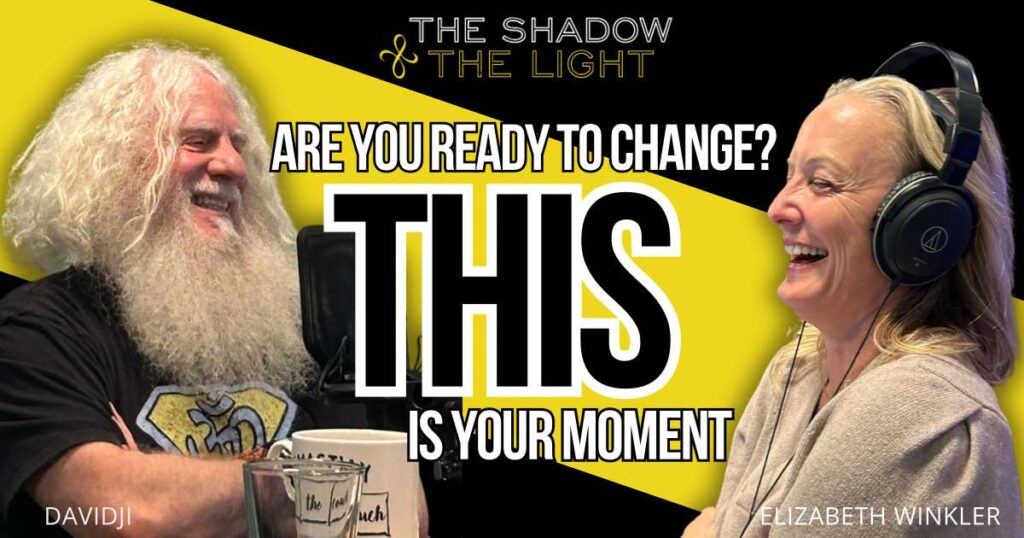
With Co-Hosts davidji & Elizabeth Winkler
Are you ready to change? This is your moment
Have you ever caught yourself thinking that people never really change? Or perhaps you’re convinced that transformation is not only possible but inevitable? This fascinating tension between fixed and growth mindsets forms the heart of our exploration into personal transformation.
davidji and Elizabeth dive deep into what makes genuine change possible, revealing that the first step isn’t focusing on others but turning inward. “Put down the magnifying glass and hold up the mirror,” Elizabeth suggests, offering a powerful metaphor for where true transformation begins.
We unpack the cycle of change – from believing it’s possible, to willingness, to taking courageous action, to celebrating small wins – and how this process creates lasting transformation rather than temporary change. But perhaps most illuminating is our discussion of how many of us live trapped in reward/punishment cycles, postponing joy while waiting for weekends, vacations, or some future moment to truly live.
Drawing from Eckhart Tolle’s wisdom, we explore how to transmute ordinary waiting periods into moments of presence and enjoyment. Those five years we collectively spend waiting in lines throughout our lives? They can become portals to mindfulness rather than sources of frustration. By anchoring in our bodies, connecting with nature, or simply noticing what’s around us, we reclaim these “wasted” moments and infuse them with meaning.
For anyone feeling stuck in patterns that no longer serve them, we offer practical techniques, including a beautiful meditation practice: “Hello, eternal loving presence.” This simple phrase can interrupt negative patterns and invite connection with your deeper self, especially during difficult times.
Whether you’re crawling through metaphorical glass or quicksand in your own journey, we remind you that honoring where you are without judgment is the first step toward freedom. And while transformation doesn’t guarantee happiness, it does lead to something perhaps more valuable—peace and a profound connection to something larger than ourselves.
Join us in this episode to discover how the journey itself, not some distant destination, is where life’s richness truly resides.
davidji and Elizabeth explore whether people can truly change, examining how our focus on changing others distracts us from the internal transformation that matters most.
- People constantly change on a cellular level, but psychological transformation requires specific conditions
- True change requires belief in the possibility of change, willingness to change, and readiness to do difficult things
- Breaking free from reward/punishment cycles helps us experience joy in the present moment
- Waiting periods (like lines or traffic) can become opportunities for mindfulness rather than frustration
- The Buddhist concept of kleshas (obstacles) explains what prevents us from experiencing our true nature
- Transformation doesn’t guarantee happiness but leads to peace and connection with something larger
- Simple practices like saying “Hello, eternal loving presence” can interrupt negative patterns
- Using the body as an anchor helps bridge from mental distraction into present moment awareness
If you’re struggling with being stuck in patterns that no longer serve you, honor where you are wit
We transform the world by transforming ourselves.
Share this podcast with your friends, loved ones, and workmates.
Visit davidji.com & elizabethwinkler.com for additional healing resources.
Big shoutout to the amazing Jamar Rogers for creating such powerful music and lyrics for the official song of The Shadow & The Light Podcast!
Transcript generated by AI:
Music: 0:00
I will not be afraid of the shadows in the dark. They will lead the way to the hidden pathways of the heart, To that secret place that is where I find my start.
Elizabeth Winkler: 0:17
Welcome to the Shadow and the Light podcast with internationally renowned meditation teacher, davidji.
davidji: 0:23
And heart healer and psychotherapist Elizabeth Winkler, as we guide you through our unique fusion of ancient wisdom and modern psychology.
Elizabeth Winkler: 0:33
Get ready to awaken your true essence, heal your wounds and transform your shadow into in tune.
davidji: 1:02
Hi, davidji. Oh, hello there, Elizabeth. Here’s what I’ve been thinking about, because I’ve heard one person say to me just a few days ago that person, I’ve been trying to change them for 30 years. They’ve never changed. People can’t change. You think they’re changing? A leopard never changes its spots. And then I heard someone else say because I actually teach this on a consistent basis of course people change. There’s a couple of rules and reasons and things that have to happen. But, yes, people can change. And then, of course, we can get into the conversation of change or transformation, which are two totally different things as well, but I know you have a fairly strong opinion on that. So, can people change?
Elizabeth Winkler: 1:47
Of course, and what I would say is put down the magnifying glass and hold up the mirror, put down the magnifying.
davidji: 1:56
Is this something you told Sherlock Holmes?
Elizabeth Winkler: 1:59
No, everyone’s looking at other people saying what’s wrong with them and magnifying that and focusing on that and they should do this and they don’t change. But guess what they’re likely also doing Filling in the blanks. We’ve talked about this a lot. They’re not even having a relationship with that person. They’re having a relationship with their projection and assumptions and concept of the person that they’re talking about. Who’s always changing? Always changing Can’t step in the same river twice. You’re a river, I’m a river, we’re all rivers. So is everything changing? Science tells us so. That’s absolutely true. We’re all holding on so tightly to our belief systems and our assumptions and our projections, and all of the beliefs that I hold on about me affect you and how I see you, and so the real way into change, transformation, is to go within. So that’s why I put the magnifying glass down, hold the mirror up and start to look at what are your assumptions.
davidji: 3:06
And what do you say to the people who say, no, that person’s lazy. They were lazy when I met them 20 years ago. Or here’s a person. They keep claiming they’re going to turn their life around and they never did. And what about this person here? What do you say to all those people who, on the surface, perhaps did not change?
Elizabeth Winkler: 3:25
Okay, First of all, that person that’s saying all that do they want to come and have a conversation with me about this? Because if they don’t, that’s fine. I’m like I’m not asking them to come to my office. You know, someone is being really righteous, that felt very righteous or like pointing, pointing this person needs to change and this person and that I just point a lot because I’m from Queens this person needs to change and this person and that.
Elizabeth Winkler: 3:43
Well, I just point to that because I’m from Queens, so if that person wanted to talk to me about it, if they were willing, that’s really important. Are you willing? Because there’s something in you that this is all directed by.
davidji: 3:56
They’re probably not going to talk to you. It was just in a conversation we were having where they said, oh, you know this person who we’ve known for 25 years. I go, yeah, what are they up to? And they’re like exactly what they were up to when we were in high school Nothing or no good, or you know things along those lines. So you know, a lot of people feel right in relationships always trying to change the partner, and then the partner is too resistant to change, like no, they’re not just not going to change.
Elizabeth Winkler: 4:24
So what is your definition of change versus?
davidji: 4:26
transformation, change you can always change back. You can change your hair, hairstyle, change it back. You can change the channel, change it back. Transformation no going back. Once you have taken that step, no going back. There is no path to return to what was. But people can change. I mean, you wouldn’t have a meditation teacher training if you didn’t believe people couldn’t change. A core part of the Masters of Wisdom and Meditation Teacher Training is to do a lot of introspection and a lot of self-reflection.
davidji: 5:02
Which is the key to change, and a lot of self-reflection, which is the key to change, and even one of our weekly lessons I shouldn’t be giving this away is based on do you believe people can change and, if you do, and submit a two-minute video on whether they can or cannot, and what’s your evidence to support what you believe?
Elizabeth Winkler: 5:18
Okay, I’d love to hear more on this. So what is the theme You’ve now? You have hundreds of teachers, so you’ve heard a lot of videos. What is something that you hear on these videos? What do?
davidji: 5:30
you get. It’s probably like two lanes One, yes, absolutely, and the other is well, they tried, but they really just could never get out of their own way. I believe that there needs to be these multiple steps to the process. So, number one, you have to believe. So you think, oh, everyone’s changing, and I would say au contraire. Au contraire, I don’t know that everyone’s changing in every single moment, but, number one, no, but physically, it’s true, Like you’re always changing your body’s changing Right, of course. Cellularly. Every eight weeks we change our stomach lining.
Elizabeth Winkler: 6:09
That’s what I was saying. Completely yeah, so I’m saying that’s an actual fact.
davidji: 6:14
Yeah, okay, I believe people can change. Not everyone has that same belief. It’s an opinion. It’s okay. If everyone doesn’t have that opinion, you are emphatic about it. I just wanted to bring it up because I thought it would be a great thing to discuss.
Elizabeth Winkler: 6:28
I mean, I’m in the business of change.
davidji: 6:29
Yeah right, Well, me too. But I know that there are people who don’t believe that people can change.
Elizabeth Winkler: 6:36
And that belief will keep you stuck.
davidji: 6:38
Mm-hmm, because beliefs are what block us, right? Let me just go back to that example of the partnership. A long time ago there was an off-Broadway show in New York called I Love you, you’re Perfect. Now, change was the title of the show, right, because that’s what happens when we meet everyone I love you, you’re perfect. I love the way you do this, I love the way you do that, I love the way you do this, I love the way you smile and the way you talk and the way you eat and the way you snuggle and like all that.
davidji: 7:04
But there’s a bunch of stuff that you need to change as well. And then you know when that doesn’t work out for the person who’s trying to inflict the new change on to the person, who is amazing to begin with. You know that’s where they go. They don’t change. I see this a lot with people who are in the throes of addiction. But let me just walk you through what I believe is necessary and why I do believe it’s so hard. So, number one you have to have the first thought. Of course I can change, of course. Number two then you have to really want to.
Elizabeth Winkler: 7:40
Yeah, willingness.
davidji: 7:41
Right, because I could say, yeah, people change, but I’m not willing to do different things or take any steps. So what are the chances that I will even move towards that transformative space?
Elizabeth Winkler: 7:53
It’s like someone being thrown in rehab who’s not a willing participant, or someone dragging their husband to therapy but they’re not a willing participant. It doesn’t work.
davidji: 8:03
Right, yeah, right, okay. So that brings us to number three. Then you have to be willing to do the scary thing or the hard thing.
davidji: 8:12
That was different than what was going on in the world of no one ever changing Right. Look at the mirror. Then, when you do that thing, then you need to celebrate the mini win, because I think there needs to be at least some kind of stake in the ground or reinforcement of hey, I did that scary thing that I was not going to do, but I did it, let me celebrate, let me have a great meal, let me go shopping or whatever that is. And then you need to do the scary or the hard thing again, which takes you all the way back to then you need to say, of course I can change. And the cycle continues. I believe everyone can change, but I don’t believe everyone who wants to change for the better of themselves does.
Elizabeth Winkler: 9:01
Yeah, so you’re making me think of something that I think could be connected to this. I work a lot with all kinds of people and recently I was doing a session with someone and they were talking a lot about reward, A break from a substance that they, you know, enjoyed. Now may not be an addiction, but just decided to not really sure, honestly, so they’re taking a break.
davidji: 9:32
But they use it to self-medicate.
Elizabeth Winkler: 9:34
Well, they were overusing it. Okay, so they’re not like in rehab or anything like that and we’re doing therapy, but it was a reward, right, and or that’s how this person viewed it. A lot of us live in this lane of reward and punishment reward and punishment, and I see this a lot when it comes to addiction, or even not addiction. It could just be. You know what we’re defining, as you know. Well, I worked a long day. I’m going to go out and I’m going to go buy myself something. Or I worked a long day and I’m going to have a drink, or I’m going to go do this thing, like I’m going to get through the thing so that I can have the thing right. But this creates this stuckness in our lives, because when you’re living in this reward and punishment lane, you get both.
davidji: 10:22
This is why people, when they get very, very rigid in their diets and go like it’s my cheat day, same exact thing.
Elizabeth Winkler: 10:29
Actually you think that you’re liberating yourself because, okay, now I get to have dessert. Like, okay, I went a week and on Sunday I get to have dessert, that’s great. Then when you’re back in Monday, you’re in the punishment zone. Whether you realize it or not, like this paradigm, this duality in your mind is creating this sense of stuckness, but it’s very deep.
davidji: 10:50
It’s very, very deep.
Elizabeth Winkler: 10:51
Yeah, no, I saw it very clearly when this person was saying I want my reward. This person was in a scenario. They were taking a break, I’m just going to name it. They were taking a break from sugar Okay, no-transcript is happening to me and that I’m not choosing this for a period of time. So that’s where I first saw that there was like this reward punishment thing going on and then it just kept coming up over different sessions and looking at well, I want to do something else because I’m just feeling so trapped in my life I don’t have that sugar thing anymore. So, like, what else can I do to like reward myself, because that thing’s gone and we know nature abhors the vacuum. So like, what else fills that reward place? So where? So? So, hmm, didn’t suggest that one, but anyway, because we all do this, where I went with this is I thought of Eckhart Tolle in his book A New Earth, and he talks about enjoyment when we’re in a reward.
Elizabeth Winkler: 12:16
It’s a goalpost, it’s in the future. You know, we’re working towards it. I’m working through my day so that I can have that good meal. I’m working through this week so that I can have that good meal. I’m working through this week so that I can have my weekend, or I’m working through this month so that I can go on my vacation and have freedom. It’s like we’re in these waiting zones. People should do just what I do.
davidji: 12:34
Work every single day. Every day is a joy.
Elizabeth Winkler: 12:38
So we’re in these waiting zones and, like I think it was 10 or 15 years ago, I wrote an article, so I’m sure that this data is no longer exact, but at that time I was looking at waiting times. We spend five years waiting in lines, at stoplights, all these kinds of scenarios. And so in this article I wrote, I said what if we shifted our waiting times to enjoyment or noticing mindfulness practice? So I’m in the Starbucks line, instead of being pissed off it’s not moving very quickly or whatever, which is totally an option I could just notice what’s happening inside my body, which is a great way to get mindful of your body, put your awareness on your feet, put your awareness on your heart, or notice what’s happening around you. If I’m sitting at my desk in my office and I’m waiting for someone to come on Zoom, I can just look out the window. There’s trees, I can notice that. So noticing nature is a really great way to bring you back into the present moment, to keep you in the present moment. This is how we take meditation off the cushion and into our lives, and so when you’re waiting these long lines, you can complain, which is just going to make it worse and you’re going to suffer more, which is totally optional, and you can also start to just notice what’s happening inside you or around you or connect with somebody right? So if you start to do this, why am I doing this? Not just because I want you to practice mindfulness. That’s not my agenda here. I want you to enjoy your life. If your life is only in the weekend or the vacation away, you are limiting your abundance, you are limiting your ability to actually have a fulfilling life. If you start to use all these waiting zones, these vacant spaces, you can start to fill them up with mindfulness and you may enjoy your life more and have more meaning, which might feel subtle or it might be profound.
Elizabeth Winkler: 14:34
I do try to practice this myself and I have a little thing that happened to me. It was in the last year. I went to some appointment and I had to get back to my office, and so I had given myself plenty of time. But I’m in one of these parking lots in Beverly Hills. There are multiple levels and it typically takes a bit of time to get out, but it was not moving. There was no movement, and I’m in my car and I have a client. My client wasn’t for 45 more minutes, but it was looking like I was going to sit here.
davidji: 15:06
I’m feeling anxious just hearing about you sitting in the car.
Elizabeth Winkler: 15:09
So I text her and I’m like, hey, I don’t know what’s going on. There’s a chance I’m going to be late. Just letting you know I completely was in a complete surrender. There was no anxiety, there was nothing. I mean, it was one of those moments where you’re like wow, like I’m so relaxed. What am I going to do? It is what it is, and I was doing that practice and I just sat in my car and this was the best part, because I’m sure a lot of people were like my former self, that would have been angry and frustrated and wanting to know why this is happening and how. You know there’s anyone operating this place, like sort of thing, right.
Elizabeth Winkler: 15:41
So I get all the way down I don’t know 30 minutes, I don’t know how long it took. It took a long time. And I look at the woman who’s there trying to get people out and I looked at her with so much compassion. I don’t remember what I said. I said something like it must be really tough dealing with this. I said something to her because I just felt connection to her. You know, I wasn’t in me versus you lane, kind of. It’s the same thing as this reward versus punishment. Anyway, it’s an example of working with low hanging fruit when you’re standing in the Starbucks line, because when you do that over time, you all of a sudden are in this thing where you’re having to wait 40 minutes and you’re like, okay, I guess that’s what I’m doing and I’ll get there. When I get there, what am I going to do? I can only do what I’m doing. So what is the purpose of that? You enjoy your life more.
Elizabeth Winkler: 16:32
I brought up Tolle, because Tolle talks about in that book. He says if you have to get the Kleenex at the other side of the room, don’t be transactional about it. The goal is to get the Kleenex when you’re walking across the room. Walk across the room, be in your body, be in that experience. That’s an experience and when you get the Kleenex, you get the Kleenex. This is living in the present moment. This is the power of the present moment, what you teach all day long. So these are little ways we can bring in, little things to allow us to enjoy our lives more. This comes back to reward and punishment. If I’m doing more of that, I’m not so addicted to the reward. I need the reward because I’m actually filling myself up all the time. Even when I’m waiting at the stoplight, I’m filling myself up in a subtle way.
davidji: 17:25
This is really what Eckhart is referring to here. Here you are on one side of the room and there are the tissues on the other side of the room, and there’s a giant cavernous expanse between those two. If your attention is only on you and the Kleenex. Which is the same as reward and punishment, then you’ve missed the 95% of the experience.
Elizabeth Winkler: 17:49
Yeah, I mean, it’s a small example of a bigger thing. So someone could hear that and be like are you kidding me? Of course, I’m just going to go get the Kleenex. I can roll their eyes, but it’s a bigger teaching than that. It’s the same thing as waiting for Friday to have a good time. It’s exactly the same thing. It’s like are you being transactional with your life and condemning yourself to be in a punitive state until you get the reward? In his book In a New Earth he’s talking about when you are living an awakened life, you transmute your waiting periods into enjoyment periods. So this is how we can have more joy, more peace, more presence and more connection in our lives.
davidji: 18:31
One of the things that I always recommend to people, and I will recommend it to everyone who’s listening right now. I used to when I was in a doctor’s office, certainly as a kid we’d have the highlights magazines, of course there are no magazines inside any.
davidji: 18:46
Maybe it’s Glamour or Elle. They’ve replaced highlights. Even at the pediatrician it’s Glamour and Elle and I just meditate in all those places. It doesn’t matter, I’ll let them be my meditation timer. I come in, I check in, they go, give us your insurance card, I show them, I sit down, close my eyes, usually doing like om, ah, hum, over and over and over and over and they’ll call my name. Sometimes I’m snapped right out of it, other times they have to repeat it. Mr davidji, for me that’s filler time. Used to be reading time, you know Goofus and Gallant back in the day, but now it’s meditation time. And that was the first thought when you were telling the story. I was like, oh, sitting in traffic and it’s not moving, perfect, put it into park, not on a highway ever or a road. I live in LA. Put it into park, not on a highway ever or a road.
Elizabeth Winkler: 19:36
Yeah, I mean, I live in LA Highway or a road ever, maybe on the 405.
davidji: 19:41
In a parking lot, absolutely Pop it into park and I’ll use someone’s honking at me to move forward as my meditation timer. Let me fill it with something that’s gonna fill me.
Elizabeth Winkler: 19:52
It’s actual enjoyment of the present. What do you say? The precious present moment.
davidji: 19:56
The sacred, precious present moment.
Elizabeth Winkler: 19:58
Sacred, precious present moment Enjoying. I think enjoying is the key to more abundance in your life. And who doesn’t want to have more abundance? So find the little spaces where you’re waiting and start to notice your feet, start to notice your body, start to notice what’s happening around you, and I promise you it will benefit you in the long run. And in that moment as well, you’re not just living in the destination, you’re in the journey.
davidji: 20:25
Yeah, Well, you know we’ve seen that meme a trillion times, but that doesn’t make us live it.
Elizabeth Winkler: 20:33
I’m trying to tell you how.
davidji: 20:34
And life is A journey. It can only be a journey. It isn’t a destination.
Elizabeth Winkler: 20:39
Destination is death, right, right, that’s where we’re all ending, or that’s where our body’s ending, right, and so how do you live a more fruitful life? I mean looking at death as a wonderful teacher, right? So, at the end of my life.
davidji: 20:51
There’s actually a term for that. In Sanskrit it’s called, which means moving towards the opening.
Elizabeth Winkler: 20:54
Yeah, and so when you?
davidji: 20:55
But we’ve been doing that since we came out of the opening.
Elizabeth Winkler: 20:58
Absolutely. So you know at the end of your life, what will you be grateful that you did, what will you be grateful that you committed to today, what will you be grateful that you let go of? These are things you can ask yourself each day and that’s how you can live more on your path of purpose. If we live in reward and punishment, which is an egoic trap, it doesn’t have to be that way. It doesn’t mean that you aren’t getting rewarded, but it’s deeper than that. Joy is what we really want. The reward is like feels good, and then it’s like, oh, and then you’re just kind of bored. You’re bored and bored and you need more, you need more, I need more, I need more. I mean, this is addiction. So it’s like okay, start to look at that more deeply and find ways.
davidji: 21:49
I never want to push the listener off of one pod into another pod, but you know our episode on nervous system regulation, that was really where we really went so deep into that concept as well.
davidji: 22:02
So I would recommend that that’s like a great follow-up to help you stay a little more in the present moment. But you know, when I say can people change, it doesn’t necessarily mean like, of course, we know that our cells are dying and new cells are being born. We know that our physiology is evolving. Well, you hear this on a consistent basis where people telling you their story, the same story over and over and over, and they’ve gotten so deeply invested in that story and ultimately became so loyal to that story that unless through your magnificent work, you can snap them out of that, introduce a pattern, interrupt, introduce a mind shift in some way or a heart shift so they can see the world differently. But I think not everyone has had the good fortune to listen to you on this podcast or work with you as a therapist, and I think there’s a whole world out there, in my opinion, of people who are very, very comfortably convinced that people don’t change.
Elizabeth Winkler: 23:08
Well, if you’re holding onto a story, probably we have a mind. It likes to make up a lot of things about a lot of things and that’s often not true, and so questioning your story is key. So, if anything, we’re questioning, questioning, questioning that and hopefully living more present, which isn’t really a story. Of course, there are things that happened in our lives and they had an impact, and using that to help us find the direction that we are desiring. That’s useful. But being wedded to a story can really limit you, but that’s okay. We all get wedded to things. We all get stuck in things. It’s not about condemning that, it’s just is that really working out for you? So, going back to the reward and punishment, I think we all do this in particular ways and we can take a look at that. We can take a magnifying glass to look at where am I doing that and then hold up the mirror and see you know, is that really holding me hostage?
davidji: 24:10
Yeah, I love that there’s this concept. The Buddha spoke about this, patanjali spoke about this 600 years later and Patanjali was doing this 2,000 years ago. And it’s this concept known as the kleshas. The kleshas K-L-E-S-H-A. You can translate that to be poison or obstacle, and the kleshas are the things that blind us to the truth of our existence. You could live a life where you’re pretty happy, you’re born, you go through it and then you die and not have any idea that transformation was even a possibility, that shifting out of what you’re in would even make a difference. I was born, this is my life, and now I’m going to die, having no opinion or judgment on whether it was good or bad, or whether I’m changing or not, whether I’m stuck or moving forward. You could live. I think there are billions of people living in that space.
davidji: 25:12
But what the kleshas block us from is the deeper understanding of ourselves. That very, very first klesha is mistaking the impermanent for the permanent. We think things are going to last forever. Nothing lasts forever.
davidji: 25:29
Every single thing in our life ultimately dissipates and dies, but we can be confused about that. We get so used to it, we get so comfortable with this thing. It happens when we’re really close to someone who’s gotten old or suddenly they’ve gotten sick and they die, and it’s like, oh, I never thought of the moment when they would leave. In that moment, I think, having that awareness that we all will leave this earth plane at some point I don’t know that that solves the heartache in advance. Well, I knew you were going to die, so I’m good with it, because we’re all going to die.
davidji: 26:03
But just the concept of the kleshas can be woven into pretty much everything that we encounter on a daily basis, and that’s what I love about these ancient wisdom teachings is that they really can be applied to our life, practically applied on a daily basis. So what’s that look like? The second klesha is egoism, our sense of self, and this is the one that I just want to put our attention on. Everyone has a different definition of ego, but the ancient definition of ego was simply sense of self.
Elizabeth Winkler: 26:33
I I mean my.
davidji: 26:34
Right, right, when you look in the mirror, what do you see? It’s not a separate self, right, the separate self. And you know, you see, oh, I’m pretty good looking. Oh, I need to pluck that hair. Oh, I need to dye that hair. Oh I need to cut that hair. Oh, I love my hair exactly as it is, All those kind of things. But our sense of self, regarding worthiness or anything else, but just our sense of self, Now it’s not always like oh, the ego, it’s the mastermind, the manipulating mastermind that’s ruining every moment and creating everything. It’s just a sense of self. And so the third klesha is attachment and the fourth klesha is aversion. This stuff gets embedded in us in our very, very early years. Something sounds like something that scares us and 20 years later it sort of kind of sounds like the same thing and we’re horrified.
davidji: 27:26
Yeah, same scar yeah yeah, but the same thing with aversion, yeah. So we have this attachment and we have this aversion. And the fifth klesha is abhinavesha fear of dying. Yeah, these are specific negative mental patterns that stand in the way of our true nature, and so I can’t tell you that holding up the mirror is going to make you happier in life. It may not. We’re not changing it may not, but here we are, sealed in this flesh casing for the span of a lifetime. Wouldn’t it be just really amazing to understand our true nature while we are here, or even have glimpses of it during that period of time? And these other aspects of our existence, whether that’s mistaking the permanent for the impermanent, or thinking I, me, mine, is all that there is, or being attached, or having an aversion, or fearing death in every moment, catastrophizing it through that process, all these things prevent you from self-realization, ultimately self-actualization which doesn’t necessarily bring joy or happiness.
Elizabeth Winkler: 28:55
It does bring peace, don’t you think?
davidji: 28:57
Yes, yes, ultimately, ultimately. But sometimes you have to crawl through the glass to get to the peace. You know, it’s just this part of the process. Suddenly you realize, oh, crawling through the glass, my mother dying. It had to happen because it brought me to this moment. And if those things don’t happen, this moment doesn’t exist. And in this moment I feel whole and so connected to the entire universe.
Elizabeth Winkler: 29:22
Yeah. So anyone who’s feeling like they’re in the glass, rolling around in it and stuck in their room of glass and bleeding everywhere, whatever that is, let’s first just notice that, be aware that that’s where you are. And what if you were to like just honor and respect that that’s where you are and not be in any form of denial around that, if that’s true, because sometimes we’re trying to distract ourselves with lots of things so that I don’t need to look at the fact that I’m in a room of glass, that I’m walking around and hurting myself, you know so just and it’s not always glass.
davidji: 30:04
Sometimes you’re just crawling through quicksand.
Elizabeth Winkler: 30:07
Yeah, I mean, that’s just the metaphor you gave me, so I’m working with that.
davidji: 30:11
Just wanted to put a couple of other options out there.
Elizabeth Winkler: 30:15
Drowning. You feel like you’re drowning, you know whatever it is. So, first, just honoring and respecting. If that’s how you feel, that’s okay. It is where you are and do you need help? Sometimes we need to ask someone for help because we don’t know how to stop doing what we’re doing, whatever it may be, and so, and then I have there’s an acronym for help. It’s not mine, it might go back with help.
Elizabeth Winkler: 30:43
Hello, eternal loving presence. I did that with a client the other day. Hello, eternal loving presence, you could just pause in this moment, put your hands on your heart, whatever that thing that you’re struggling with. Honor, respect. What if, in this moment, you just said okay, yes, I am still in struggle with whatever this is, it’s still here with me, take a breath and I need help. So hello, eternal loving presence. Hello, eternal loving presence. As you continue to say those words, you are inviting in your true nature, your eternal loving presence, which is always here, and just let that be your meditation, let that be your mindfulness practice. I used to do that every morning. When I woke up, I put one hand on my heart and one hand on my belly and I would repeat hello, eternal loving presence. For like five minutes. So I’m offering that as a simple way to, just you know, have an interruption in the pattern.
davidji: 31:48
Take it a little further, because this would be time for today’s takeaway living the light.
Elizabeth Winkler: 31:55
So, whatever you’re going through, if you’re living in a place of next week, I’ll have a good time, or on Friday or next month or next year, like, how are you condemning yourself with this state of reward and punishment? Are you willing to start to just notice the little moments, the little spaces, to come more in contact with your body, which is always present? So use your body as your anchor into the present moment. It’s always present, so it’s your friend to help you bridge out of your head, out of your distraction, into the present moment. Use it as an anchor. Feel your feet, feel the sensation of the chair beneath you or the sensation of the steering wheel, feel your breath. Do that, notice nature. These are different ways for you to contact the sacred, precious present moment and allow yourself to enjoy how that feels, and when it doesn’t feel good, that’s okay. Allow yourself to breathe with that. Ask for help. Hello, eternal loving presence, wow.
davidji: 33:13
Damn, you’re good. I am sitting here in the presence, in the sacred, precious presence, of Elizabeth Winkler, the psychotherapist beyond the stars. My name is davidji Jamar. You wrote such a magnificent song. Would you sing it to us now as we say goodbye?
Music: 33:31
The light is here to remove all my fears and to bring new sight the light is the time that will go to the deep to take me to you. The light, the shadow and the light. There’s no fog and rock bottom. You hold it as your own limit, but don’t rush past this moment. The darkness can become a friend. Love will come by your side and you’ll shine brighter than a million suns a million suns. You went through hell, but now you’re in the light.
Music: 34:34
It is here to remove all your fears and to bring new sight the light. It is now that we’ll go to the deep To take you to the light, To the light. The light has come because, in our lives, the light has come to set us free. The light has come to set us free. The shadow comes because it loves us. The shadow comes because it loves us. The shadow comes to set us free. The light is here to remove all our fears and to bring new life. The light Is the light that will go to the deep To take us to new heights. The shadow and the light.